Top 5 Emerging Technology Trends
Top 5 Emerging Technology Trends:
1. Agentic & Generative Artificial Intelligence:
Agentic and generative artificial intelligence (AI) represent the evolution of intelligent systems capable of independent reasoning, planning, and creativity. Agentic AI refers to systems that can autonomously perform complex, multistep tasks without direct human control—essentially becoming digital “co-workers.” Generative AI, on the other hand, can create new content such as text, code, images, or music. These technologies are already transforming industries like marketing, software development, education, and healthcare by automating creative and cognitive processes.
The growing integration of AI into daily operations means that machines are shifting from tools to intelligent collaborators. Organizations are using AI agents to streamline workflows, make data-driven decisions, and improve productivity at scale. However, this transformation also raises ethical concerns around transparency, bias, and data privacy. As AI agents become more autonomous, developing regulatory frameworks and responsible AI practices will be essential to ensure safety, trust, and fairness in their applications.
 | |||
| Agentic & Generative Artificial Intelligence |
- AI systems can autonomously plan, act, and generate creative outputs such as text, images, or code.
- Used across industries for automation, customer service, design, and data-driven decision-making.
- Raises concerns about ethics, transparency, and the need for strong governance frameworks.
2.Human-Machine Collaboration & Spatial Computing
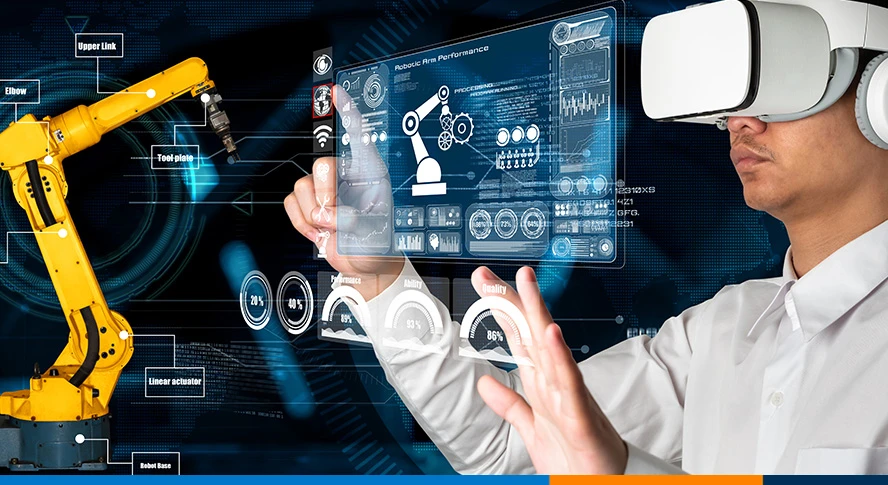
Human-machine collaboration is being redefined by immersive technologies such as augmented reality (AR), virtual reality (VR), and spatial computing. These technologies blend digital and physical environments, allowing humans to interact with 3D digital objects as if they were part of the real world. In workplaces, this means that engineers, designers, and doctors can visualize and manipulate complex systems in real time. Collaborative robots, known as “cobots,” are also making manufacturing safer and more efficient by working alongside humans rather than replacing them.
The future of work is shifting from automation to augmentation, where technology enhances human capabilities rather than eliminating them. In education and training, for example, immersive simulations are improving skill development and safety outcomes. As hardware like headsets and sensors become lighter and more affordable, spatial computing will become accessible to more industries. This trend promises not only increased productivity but also a more engaging, intuitive way of working and learning in hybrid environments.
3. Edge & Specialized Hardware
Edge computing and specialized hardware are emerging as critical enablers of high-performance technology ecosystems. With the explosion of data generated by IoT devices, sensors, and AI applications, processing everything in the cloud has become inefficient. Edge computing solves this by processing data closer to where it’s created—reducing latency, saving bandwidth, and enabling real-time decision-making. Specialized semiconductors, such as AI accelerators and custom chips, are designed to handle specific tasks faster and more efficiently than traditional processors.
These hardware advancements are particularly important for AI, robotics, and autonomous systems that require instant responses. For example, self-driving cars rely on edge computing to process sensor data instantly for safety. Similarly, factories use AI-enabled chips to optimize production in real time. As global demand for computational power increases, innovation in chip design and distributed computing will define the next era of digital infrastructure. However, these technologies also require sustainable energy management and global collaboration to ensure equitable access and environmental responsibility.
Specialized Hardware |
4. Cybersecurity, Trust & Governance
In an increasingly digital world, cybersecurity and trust have become fundamental pillars of technological progress. The rapid adoption of AI, IoT, and cloud computing has created vast interconnected networks—each posing new risks for privacy, data breaches, and system manipulation. Emerging models like the “cybersecurity mesh” architecture aim to create adaptable, decentralized security frameworks that can protect distributed systems. Blockchain and digital identity verification are also playing key roles in ensuring transparency and accountability in digital ecosystems.
Beyond protecting data, cybersecurity is now about maintaining digital trust and resilience. Governments and organizations worldwide are prioritizing governance frameworks that address ethical AI, privacy regulations, and responsible data usage. As technology becomes more autonomous, ensuring that systems act within ethical and legal boundaries is vital. Trustworthy technology will not only protect users but also accelerate adoption by making people feel safer in digital environments. The future of innovation depends as much on security and governance as it does on creativity and efficiency.
Cybersecurity, Trust & Governance |
5. Sustainability & Green Technology
Sustainability has become one of the defining themes of modern technological innovation. Green technologies aim to reduce environmental impact through cleaner energy sources, efficient materials, and waste reduction strategies. Advances such as structural battery composites—materials that act as both structural components and energy storage—demonstrate how innovation can align with ecological responsibility. Renewable energy systems, circular economy principles, and AI-driven energy management are reshaping industries to become more resource-efficient and climate-conscious.
The integration of sustainability into technology design ensures that innovation supports long-term planetary health rather than undermines it. Businesses are increasingly being held accountable for their carbon footprints, leading to the rise of “green computing” and environmentally responsible manufacturing. Governments are also incentivizing clean technologies to achieve global climate targets. By embedding sustainability into the core of technology development, societies can drive growth while ensuring a cleaner, more equitable future for generations to come
Comments
Post a Comment